New AFSA report finds hunger up 58% across AGRA’s target countries since 2006 — while Senegal, never part of the programme, cut hunger in half
Twenty years ago, the Alliance for a Green Revolution in Africa launched with a promise: commercial seed, synthetic fertiliser and better market access would lift yields, raise incomes and cut hunger across the continent. This week, as AGRA marks that twentieth anniversary with a continent-wide celebration tour, a new report from the Alliance for Food Sovereignty in Africa (AFSA) puts that promise against the record — and finds it broken.
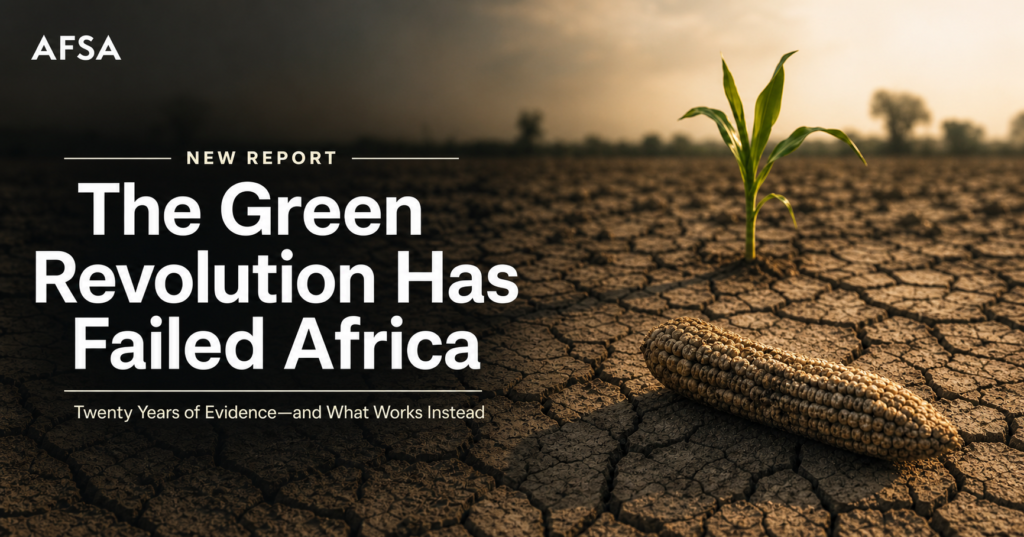
The Green Revolution Has Failed Africa: Twenty Years of Evidence and What Works Instead, released today, is the most detailed independent assessment yet of what two decades and billions of philanthropic dollars actually bought the thirteen countries AGRA prioritised. The numbers are stark. The count of chronically undernourished people across those countries has risen 58% since 2006 — nearly double the 31% increase already flagged in an earlier assessment in 2020. That’s against a programme that set out, explicitly, to cut hunger in half.
Fertiliser use more than doubled over the same period. Cropland expanded by 46%, as forests and grazing land were cleared for cultivation. Yet staple-crop yield growth actually slowed compared with the twelve years before AGRA began. Much of the additional food produced came from farming more land, not farming it better — and the crops that historically carried households through drought, millet and sorghum among them, lost ground as maize monocultures spread.
Malawi illustrates the paradox at the centre of the report: it recorded the strongest yield growth of any country studied, and hunger still climbed there by 61%. Growing more of one crop, the report argues, is not the same as building a food system that can feed people through a bad season.
The report singles out Senegal as the clearest counter-example. Never an AGRA focus country, Senegal achieved over the same period exactly what AGRA set as its own target and failed to reach: it cut hunger in half, bringing it below 5% of the population, while using roughly half the fertiliser applied in a comparison country like Zambia. Millet production rose 85%, sorghum 75%. Senegal did this by keeping its farming systems diversified rather than narrowing them to a single input-heavy package.
“The agroecological alternative isn’t theoretical. Farmers are already building it — restoring soils, protecting their seeds, diversifying their farms and reducing dependence on expensive external inputs,” said Million Belay, General Coordinator of AFSA and a member of the International Panel of Experts on Sustainable Food Systems. “It’s time to fund what works.”
The report lands alongside a second, independent assessment — Requiem for Africa’s Green Revolution, by Timothy A. Wise of Tufts University’s Global Development and Environment Institute, published August 17 — reaching similar conclusions from separate data.
For Mutinta Nketani, National Coordinator of the Zambia Alliance for Agroecology and Biodiversity, the findings describe a country she watches every day. Zambia spends up to 72% of its national agriculture budget subsidising a single input package, and maize yields there rose just 14% while cultivated land nearly doubled. “After billions poured into AGRA-aligned policies, farmers have only grown hungrier and more in debt,” she said. “We cannot continue this way.”
The report’s release is timed deliberately. African governments are currently drafting the next ten-year agricultural strategy under the Kampala CAADP framework — the document that will direct billions in public, development and climate finance for the decade ahead. The African Union’s own scorecard found that not one of forty-five countries met its targets under the previous ten-year plan. AFSA’s report warns that the new strategy risks carrying the same model forward at greater scale, through the African Development Bank and the World Bank, with input-heavy programming increasingly rebranded as “climate adaptation” to draw in climate finance.
The report’s central recommendation is a redirection, not new spending: 10% of existing agricultural finance shifted toward farmer-managed seed systems, soil health and diversified production by 2028, rising to 25% by 2030 and 33% by 2035. National agroecology laws already exist in six African countries, with five more currently drafting their own — evidence, the report argues, that this isn’t a future experiment but a policy path communities have already chosen.
“African farmers must stop being treated as beneficiaries of someone else’s transformation,” Belay writes in the report’s foreword. “They must be its authors.”
The full report, launched today at a press conference moderated by author and academic Raj Patel with Belay, Nketani, Famara Diedhiou and Timothy Wise, is available now.
Read the full report: The Green Revolution Has Failed Africa