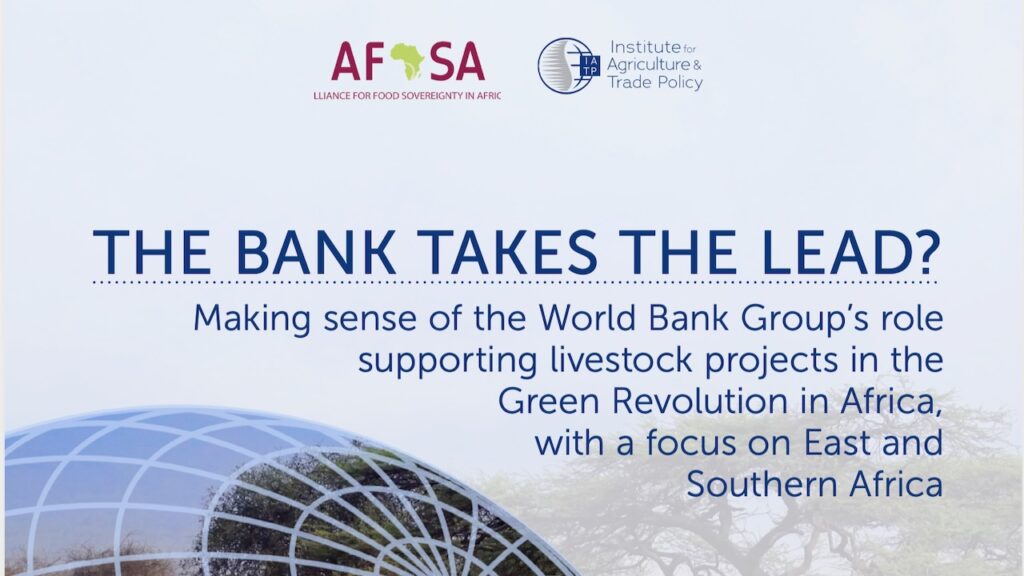
AFSA and IATP today launch a new report assessing the World Bank Group’s involvement in African agriculture since 2014, with a particular focus on its investments in livestock agriculture in East and Southern Africa.
The question of World Bank Group involvement has become increasingly important in recent years. Leading proponents of the so-called “African Green Revolution” have either scaled back their ambitions or, in the case of USAID, collapsed entirely. Yet the wider project they helped launch around 2010, to reconstruct African agriculture on a continental scale and integrate it more deeply into global networks of trade and finance, continues.
Today, the World Bank Group may be the leading driver of this agenda. Since 2021, it has significantly increased capital expenditure in African agriculture and has recently declared its intention to expand that spending further.
Key findings include:
• From 2014 to 2020, World Bank Group financing for African agriculture averaged around $1 billion per year. From 2021 to 2024, this rose to approximately $3 billion per year. Over the full period, the World Bank Group committed about $12 billion to livestock-related projects in Africa.
• Livestock has become a major pathway for agricultural development, not only for the World Bank Group but also for many African governments. Of 49 sub-Saharan African countries, 29 have hosted at least one World Bank Group livestock project since 2014.
• Many livestock projects reflect a “productivist” approach to agricultural development. Even some projects classified as emergency preparedness or recovery place strong emphasis on increasing farmer productivity.
• The World Bank Group’s theory of change has long rested on the assumption that development requires moving people out of farming and into supposedly more “advanced” sectors of the economy. Some livestock projects reflect this logic explicitly, including stated intentions to reduce the number of farmers in a country or region.
• With its growing emphasis on networked technologies, including artificial intelligence, the World Bank Group is positioning itself at the forefront of a new technology-driven model of agriculture. Yet the underlying goals and logic of the African Green Revolution remain largely unchanged from its earlier promotion by institutions such as USAID and the Gates Foundation.
The report concludes by stressing the need to put farmers at the centre of any effort to transform African agriculture. It argues that agroecology offers a more just and effective response to the continent’s persistent hunger and nutrition challenges.