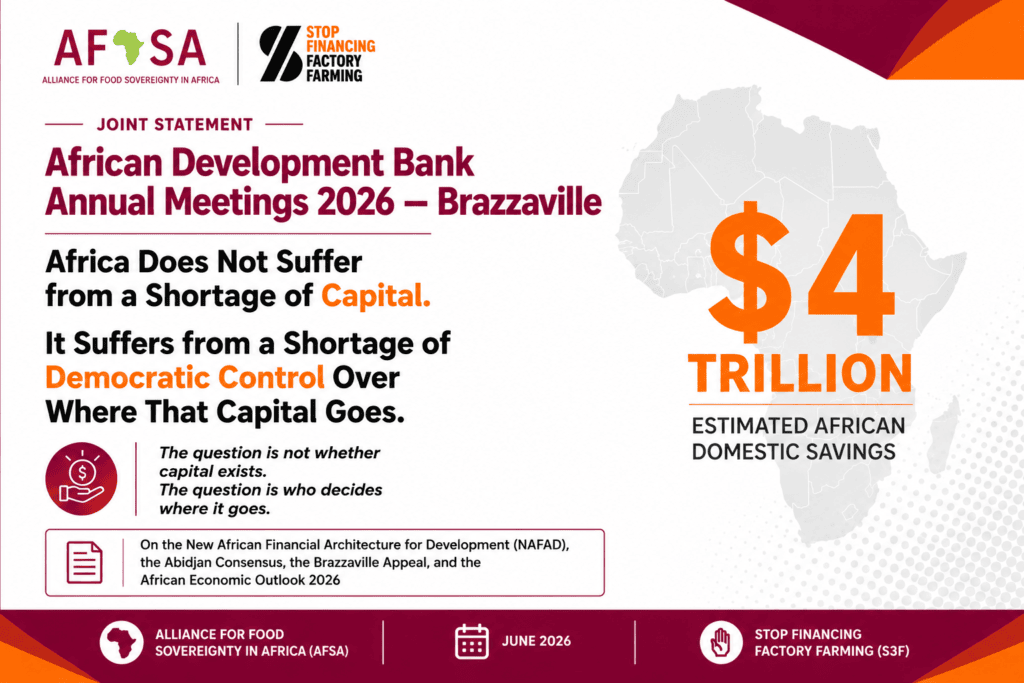
Africa Does Not Suffer from a Shortage of Capital. It Suffers from a Shortage of Democratic Control Over Where That Capital Goes.
AFSA and Stop Financing Factory Farming issue a critical joint statement on the New African Financial Architecture for Development (NAFAD), the Abidjan Consensus, the Brazzaville Appeal, and the African Economic Outlook 2026.
Issued by: Alliance for Food Sovereignty in Africa (AFSA) and Stop Financing Factory Farming (S3F) | Date: June 2026
What Happened in Brazzaville
The African Development Bank’s 2026 Annual Meetings in Brazzaville produced three interlocking outcomes: the Board of Governors’ endorsement of the New African Financial Architecture for Development (NAFAD) and the Four Cardinal Points; the launch of the African Economic Outlook 2026 framing a $400 billion annual financing gap; and the Brazzaville Appeal, through which civil society, diaspora, and philanthropic organisations were invited to “embrace the vision, tools, and objectives of NAFAD.”
AFSA and S3F issue this statement because the financial architecture taking shape in Brazzaville — however legitimately motivated — will not deliver African food sovereignty. It will scale the model that is destroying it.
What NAFAD Gets Right — And Why That Makes What It Gets Wrong More Dangerous
The diagnostic behind NAFAD is not wrong. Africa holds an estimated $4 trillion in domestic savings — pension funds, sovereign wealth, insurance assets — that are overwhelmingly invested outside the continent. Global aid fell by nearly a quarter in a single year, to $174.3 billion. The case for African capital financing African development is sound — so long as it does not end up replicating the same harmful, extractivist logics of the past.
What NAFAD fails to answer is the question that follows: capital for what? The Abidjan Consensus commits to channelling savings into “productive investment” without defining what that means. There is no agroecology commitment in NAFAD. No exclusion of corporate monoculture expansion. No protection for smallholder food systems or territorial markets. No land rights conditionality. Without a binding investment mandate, NAFAD defaults to the AfDB’s existing priorities — and those priorities are industrial, input-intensive, and corporate.
The Evidence Is Already There
AFSA’s 2025 report Tracking the Role of the African Development Bank in Reshaping African Agriculture assessed 20 AfDB agricultural projects using the Agroecology Coalition Tool. The findings are unambiguous: none of the 20 projects achieved high agroecological alignment. The Technologies for African Agricultural Transformation (TAAT) and the Special Agro-Industrial Processing Zones (SAPZ) — the two flagship Feed Africa programmes — scored lowest. Private-sector lending has expanded sharply since 2021, directed to large agribusinesses including ETG, Zambeef, and DAL Group.
Nearly half of the agricultural portfolio is labelled climate finance, yet most projects replicate Green Revolution approaches: fertilisers, hybrid seeds, mechanisation, monoculture intensification, and industrialization of animal agriculture. The African Economic Outlook 2026 confirms the picture — its 260 pages do not contain the word agroecology. Smallholder and subsistence agriculture appears primarily as a fiscal problem. This is what NAFAD will scale if its investment framework goes unreformed.
Four Structural Problems
AFSA and S3F identify four structural problems at the heart of NAFAD:
- No investment mandate. NAFAD is a capital mobilisation framework with no binding criteria requiring agroecological alignment, smallholder food system support, community land rights, or exclusion of corporate-concentrating investments. It is an acceleration mechanism for the status quo, not a transformation of it.
- Natural capital financialisation and dispossession. The Congo Basin Blue Fund ($3.5 billion in commitments) operationalises a growing narrative that Africa’s forests, wetlands, and carbon sinks should be treated as economic assets generating investment returns — not as conservation obligations or community territories. Carbon markets and biodiversity credits structured without binding free, prior, and informed consent requirements are dispossession instruments.
- Technology as the only pathway — erasing agroecology and farmer knowledge. Throughout Brazzaville, the modernisation of peasant agriculture through precision agriculture, improved genetics, AgriFintech, and proprietary seed systems was positioned as the singular virtuous pathway forward. Agroecology is not the absence of science. It is a scientifically grounded, evidence-supported approach that produces food, regenerates soils, builds climate resilience, and protects biodiversity without input dependency and corporate enclosure.
- Sovereignty claimed, democracy absent. The Abidjan Consensus was produced by central bank governors, sovereign wealth fund executives, private equity firms, and development finance institutions. Farmer organisations were not in the room. Land rights movements were not in the room. The communities whose territories will be the sites of NAFAD-financed investments were not in the room. Sovereignty requires democratic accountability over investment decisions — not just national ownership of the capital.
What AFSA and S3F Demand
AFSA and S3F call on the AfDB and NAFAD to take seven concrete actions:
- Establish a binding NAFAD investment mandate with agroecological alignment requirements, smallholder food system protections, community land rights as a conditionality, and explicit exclusions for hazardous pesticides, proprietary GMO seed systems, and large-scale monoculture expansion.
- Conduct an independent agroecological audit of the full AfDB agricultural portfolio before NAFAD channels additional capital into the existing investment pipeline — with results public and acted upon.
- Protect communities from natural capital financialisation — all NAFAD-financed carbon, biodiversity, and ecosystem service mechanisms must be subject to binding FPIC requirements and independent oversight.
- Establish dedicated agroecology financing targets within NAFAD, comparable in scale to current agro-industrial investments, for farmer-managed seed systems, territorial markets, and community-controlled food economies.
- Apply rigorous criteria to climate finance — input-intensive monoculture and livestock projects do not qualify, regardless of efficiency improvements.
- Rebuild the civil society engagement process from community upward — farmer organisations, pastoralist communities, women’s networks, fisherfolk, and agroecology movements must be present at the design stage, not only invited to implement or monitor.
- Publish full transparency on all NAFAD-financed investments, including through intermediaries and blended finance vehicles, with beneficiary data, ecological assessments, and land use information publicly accessible.
NAFAD is being designed now. Its investment mandate and governance structures are not yet fixed. African pension funds, sovereign wealth, and diaspora capital could finance an agroecological transition at scale — supporting farmer-managed seeds, territorial markets, community land tenure, and biodiverse food systems. That is the financial architecture Africa’s food producers need. It requires political will to define African financial sovereignty in terms that include the people on whose labour Africa’s food security depends. We are calling for that will to be exercised before the window closes.