
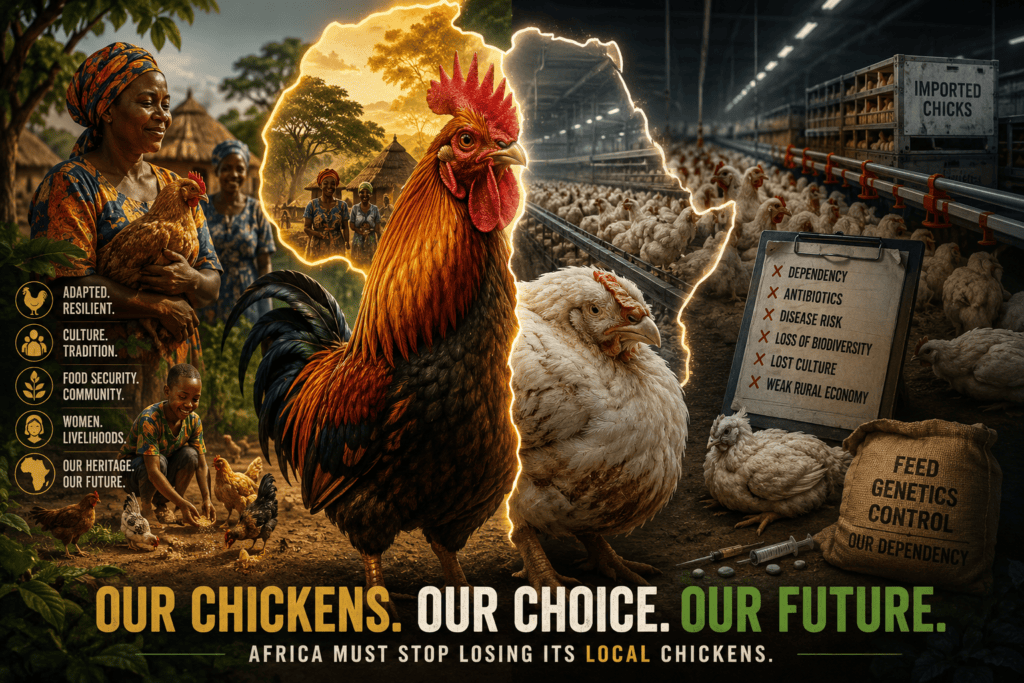
A few months ago, my sister Janet got married to her husband Nathan. It was a traditional marriage ceremony, and as her Muko (brother), I was handed a big, proud local cock by my in-laws. No speech came with it. None was needed. That bird said everything: you are family now, you are trusted, you belong here. I held it carefully, because I knew what it meant.
You cannot get that meaning from an exotic broiler.
I grew up in a small village in western Uganda with local chickens all around us. On Christmas morning, my mother would dress in her new gomesi (female fabric) and my father in a new shirt saved from the previous Christmas, and we would walk to church in our new clothes carrying a hen or a cock as an offering. It was not unusual. It was just what you did. Even the ‘secular’ neighbours the catechist frowned at, the ones we call traditionalists, kept at least one chicken of a specific colour (usually white) in their home. Not for eating. For protection. The village elders were clear about it: a home without a chicken is an empty home, and empty homes attract trouble.
When important guests came, you did not send a child to buy soda or a takeaway box from the supermarket. You went outside and picked the best local cock in the yard. You honoured people with something real.
Our local chickens were remarkable birds at that time. They found their own food, slept on tree branches and rooftops, raised their own chicks, and managed perfectly well without anyone checking on them. Up to now a local cock will always find the highest point he can, a mango branch, a rooftop corner, the top of a granary, and crow from there. He is not performing. He is simply declaring that he is home. A broiler imported from the Netherlands cannot do any of this. Such a broiler cannot even find its way back to the shed if it wanders ten metres away.
I can tell you that something has gone badly wrong.
Go to most restaurants today, from Kampala through Nairobi to Dar es Salaam, and the chicken on the menu is no longer what we grew up with. It carries the same name, yes. But it is a completely different thing. It is a fast-growing hybrid raised in crowded sheds under artificial light, on antibiotic laced feed, designed to reach slaughter weight in record time. Four or five weeks, the bird is ready for slaughter! Haha! Many of these birds cannot support their own weight by the time they are killed. The meat is soft and tasteless. My grandmother, if she were alive, would refuse to cook or eat it. Is this chicken? I am sure she would wonder!
This exotic bird is now at our school lunches, workplace dining, hospital canteens, wedding receptions, and funerals. It dominates because it is cheap and easily accessible in large quantities. “Cheap” and “available” is a powerful argument. But there are things that “cheap and available” does not tell you. We start with health risks from the methods the exotic bird is raised.
The World Health Organisation and African public health bodies have been warning for years that routine antibiotic use in animal farming is making infections harder to treat in humans. Our hospitals, say the Mulago Cancer Institute in Kampala, are already dealing with this health crisis.
There is also a dependency problem that few people talk about. Many of the popular imported breeds, including the Sasso T451 distributed under licence from Hendrix Genetics, are hybrids. Their offspring do not breed reliably. Every few months, the farmer has to buy fresh chicks, most of them flown in from Europe or Asia. Three companies, namely Tyson Foods in the United States, EW Group in Germany, and Hendrix Genetics in the Netherlands, reportedly control around 90 percent of global poultry genetics. African farmers are their customers, not their partners. It is the hybrid maize story again, this time with feathers.
Ask yourself what happens when a shipment is delayed. When the port closes. When prices go up. Does the wedding go ahead with no cock for the Muko?
GRAIN (2025) documents how Ghana, after independence, built a thriving poultry sector through strong public extension services and careful import controls, reaching self-sufficiency by the 1970s and even exporting to its neighbours. Then the World Bank and IMF arrived with structural adjustment conditions that forced the government to privatise and open its market to cheap imports from Europe, Brazil and the United States. Today, Ghana imports 90 percent of its poultry meat needs. Local commercial production has been decimated. The same story, with local variations, is playing out across the African continent. We are feeding our people with chickens flown in from elsewhere while our own birds, and the women who keep them, go without support.
The people who have always kept our local chickens, the women, the elders, the small farmers with five or ten birds, are scattered and unsupported. I used to be an agricultural extension officer some years ago. I observed that extension veterinary officers prefer to visit the large farmers with imported poultry breeds. Research money also follows these exotic poultry hybrids. The local cock is forgotten! Some donor programmes arrive with impressive looking fast-growing chicks, take a photograph, and disappear. The smallholder counts losses and is left wondering why the chicken her grandmother kept for generations is now considered backward and “unproductive”. The local bird is not a problem. The system has failed the local bird.
In our cities, a lot of young people skip necks and feet when it comes to eating chicken. It’s less about taste and more about the vibe. They’d rather have boneless pieces in a clean, branded box from KFC. But in northern Uganda, parts of western Kenya, and across much of West Africa, it’s still normal to eat every part of the bird. Not because people are forced to, but because they know those parts are worth it. When I grew up, our mother boiled chicken legs for us to prevent a possible measles disease attack. Nutritionists could explain the magic in this.
FAO Food Balance Sheets show that the average protein supply in Uganda is about 48 grams per person per day, much of it coming from plant foods such as beans, peas and cassava. This is close to the basic adult requirement of about 50 grams per day, but protein quality matters, especially for children, pregnant women and breastfeeding mothers. They need the animal protein. One egg provides about 6 grams of high-quality protein, along with important nutrients such as vitamin B12, vitamin D, choline and iron. According to 2021 national livestock census, Uganda produces about 907 million eggs per year. With a population of about 52 million people, this means Uganda produces fewer than 18 eggs per person per year (this is roughly one egg every three weeks). If every Ugandan ate just one egg per day, the country would need about 19 billion eggs per year, which is more than twenty times current production. To reach that level, Uganda would need around 127 million productive laying local hens, assuming each local hen lays about 150 eggs per year.
In ordinary village conditions, a local Ugandan hen may lay only about 40 eggs per year. This low number is not because the bird has no potential, but because she is usually left to survive on scavenged feed, poor housing, disease pressure, predators and long brooding periods. With good housing, vaccination, better feeding, manure recycling, clean water, hygiene, predator control and proper chick management, the same local hen can produce about 150 eggs per year, and sometimes more under very good management. Commercial layers from Netherlands produce an average of 200 eggs per year. Yet at a bigger cost to the environment and our culture. This means Uganda does not have to abandon the local chicken. It has to support it properly.
Is there still local chicken in Africa?
Fortunately, 85 percent of poultry flocks in Africa are still indigenous birds raised in backyard systems, and 70 percent of these are managed by women and children (GRAIN, 2025). But unfortunately, these birds rarely feature in policy discussions or trade statistics. The people who have sustained Africa’s poultry genetic heritage for generations are the most invisible in the decisions that affect it. This is not just an agricultural failure. It is a political one.
Isn’t the poultry market already fully captured by the exotic bird?
No, GRAIN wrote in its recent publication that in Zambia and Burkina Faso, indigenous chickens are more profitable for small-scale farmers than exotic free-ranging breeds. Consumers in these markets prefer indigenous birds for their taste, texture and perceived health benefits, and are willing to pay a premium for them. The market is not an obstacle. The market is actually on our side. What is lacking is the organised supply to meet it. Governments also have a direct role to play. Benin, Senegal, Namibia, South Africa, Tanzania, Zimbabwe and others have moved to ban or limit imports of frozen chicken — what Beninois communities call “poulets morgue” or mortuary chickens — from Europe, Brazil and the United States. The results have been tangible: local producers recovered markets, and dependency on imported meat declined. Uganda has not yet taken this step. It should.
The way forward is not complicated, though it requires real commitment from all of us. Local chickens need to be taken seriously in agricultural training and extension, not treated as a poor cousin to imported breeds. Smallholder keepers need better housing, better feeding programmes, targeted vaccination for the diseases that threaten their birds, and simple predator proof structures. They also need farmer cooperatives for input and product marketing, and well-designed agroecological crop–livestock systems. Near my village home in western Uganda recently, I watched a young man in my age bracket building a hedge fence around his chicken yard to keep the predators, including “human predators” away. Large sums of local birds “free ranging” yet enclosed and supported with good hygiene and supplementary feeding. A small thing. A smart thing. That is the kind of practical knowledge that deserves support in our agroecology projects and sharing in articles like this one. Smallholders need cooperatives to help them access and supply markets reliably. With such cooperatives, the “are the local chickens available” question is answered. Restaurants and institutions need to be encouraged, and sometimes pushed, to source and name local birds from these cooperatives the way good food culture works elsewhere in the world.
And we need to teach our children that ‘local’ is not a compromise. It is the real thing.
Because that local cock at my sister’s wedding last year was not just a bird. He was family history, held in my two hands, passed from one generation to the next. If we let local chickens go, we lose more than protein and organic soup. We lose the offering carried to church and other shrines, the elder’s cure, the protection at the doorway, the meaning that no exotic broiler has ever been able to carry.
Somewhere on this continent tomorrow morning, a cock will still climb to the highest branch he can find and call out. He is telling the village “I am still here”. The question is whether we are still the kind of people who hear him.

