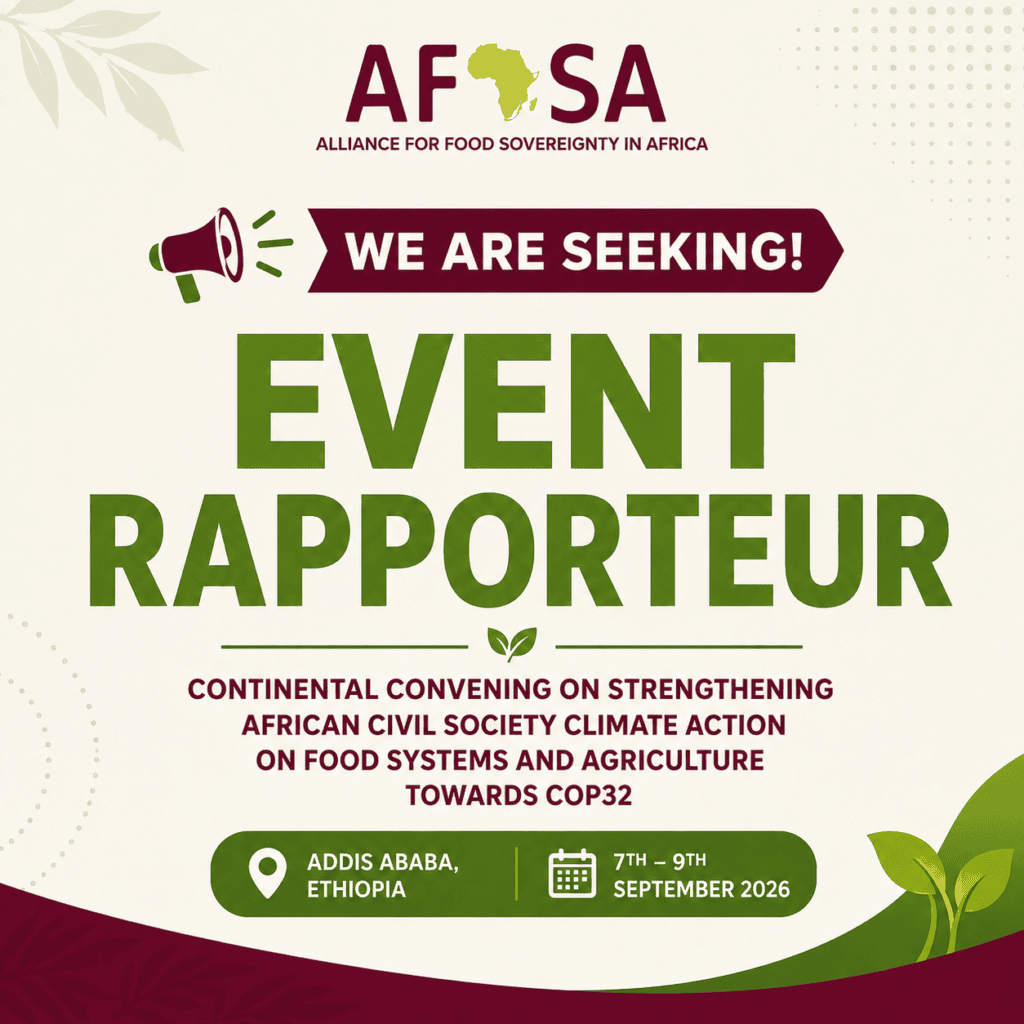
Terms of Reference (ToRs) for event rapporteur Continental Convening on strengthening African civil society climate action on food systems and agriculture towards COP32
Introduction and Background
Agriculture remains the backbone of most African economies, employing a significant proportion of the population while simultaneously being highly vulnerable to climate variability and extreme weather events. Rising temperatures, shifting rainfall patterns, prolonged droughts, floods, and land degradation are already undermining agricultural productivity, disrupting food supply chains, and worsening nutrition outcomes across the continent. These impacts are disproportionately felt by smallholder farmers, pastoralists, women, youth, and indigenous communities whose livelihoods are directly dependent on natural resources.
At the same time, agriculture and food systems offer one of the most powerful entry points for climate action in Africa. They are critical for advancing adaptation, given their direct link to resilience and livelihoods, and they also present opportunities for mitigation through sustainable approaches like agroecology. Gradually, global climate policy spaces under the United Nations Framework Convention on Climate Change (UNFCCC) are recognizing the importance of agriculture and food systems, including through ongoing workstreams related to the Sharm el Sheikh Joint Work on Implementation of Climate Action on Agriculture and Food Security and outside negotiation spaces for example the establishment of the Food Systems Hub at COP30.
With the thirty second Conference of the Parties to the UNFCCC (COP32, scheduled to take place in Ethiopia in 2027, Africa is presented with a historic opportunity to shape global climate discourse from within the continent. The outcomes of ongoing negotiations, for example the operationalization of the Belem Adaptation indicators under the Belem-Addis Vision, are expected to culminate around this period, making it essential for African actors to be strategically aligned and influential. The period leading up to COP32 therefore represents a critical window for building a strong, unified, and well-coordinated African civil society voice on climate action in food systems.
In light of the above, the Alliance for Food Sovereignty in Africa (AFSA), in collaboration with likeminded African CSOs and partners has planned to hold a convening which will bring together various African CSOs working on advancing the food systems agenda within climate discussions. The convening will act as a space for these CSOs to plan their collective engagement in forthcoming regional and global climate events including COP31 and COP32.
To ensure strategic documentation of the proceedings from this multi-stakeholder gathering, AFSA seeks to engage a professional and experienced conference rapporteur to document the discussions from the convening.
Purpose of the Assignment
The Rapporteur(s) will be responsible for documenting the discussions, outcomes, and key messages emerging from the gathering. This includes compiling a detailed report, capturing highlights, preparation of summary briefs and the civil society actors’ declaration from the convening.
Key Responsibilities
- Attend and document all sessions, including plenaries, breakout discussions, and informal reflections.
- Accurately capture key points, recommendations, action items, and stakeholder contributions.
- Support the documentation of the declaration/call to action/communique that will come out of the convening.
- Produce a comprehensive final report of the event (10–15 pages).
- Draft a 2-page summary brief highlighting outcomes, key messages, and next steps.
- Ensure all outputs reflect the event’s diversity, policy depth, and strategic direction.
Deliverables
- Daily session summaries (submitted each evening during the event)
- Draft declaration/call to action/communique that will come out of the convening (support editing and compilation with facilitators)
- Final Event Report (submitted within 5 working days post-event)
- Summary Outcome Brief (2 pages, for advocacy and dissemination)
Qualifications and Experience
- Proven experience in reporting, documentation, and synthesis at high-level policy or cultural events.
- Strong background in food systems, climate change advocacy, African development, policy is highly desirable.
- Excellent writing, analytical, and listening skills.
- Ability to work independently and under pressure to meet deadlines.
Duration and Location
The consultancy will span 8 working days, including 3 days of on-site documentation and 5 days of post-event reporting and revision. The event will be held in Addis Ababa, Ethiopia, and physical presence is required during the event.
Reporting and Supervision
The Rapporteur(s) will report to the Programme Coordinator for Climate Change and Agroecology at the AFSA Secretariat, working closely with the event coordination team and relevant thematic leads.
Application Process
Interested applicants should submit:
- An application letter outlining their understanding of the assignment and proposed approach.
- A CV highlighting relevant experience and sample previous reports.
Submissions should be sent to afsa@afsafrica.org and copy simon.bukenya@afsafrica.org not later than 21st August 2026.