After three days of dialogue among 187 delegates from 20 countries, the Second Congo Basin Convening closes with a declaration that puts numbers, deadlines and a mandate behind its demands
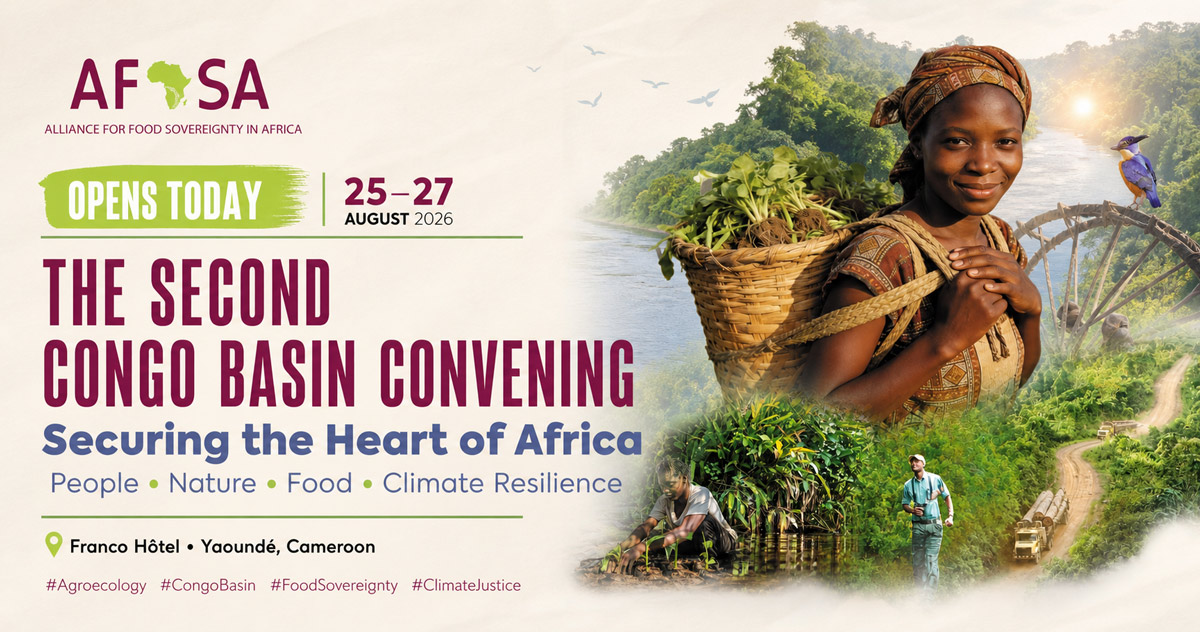
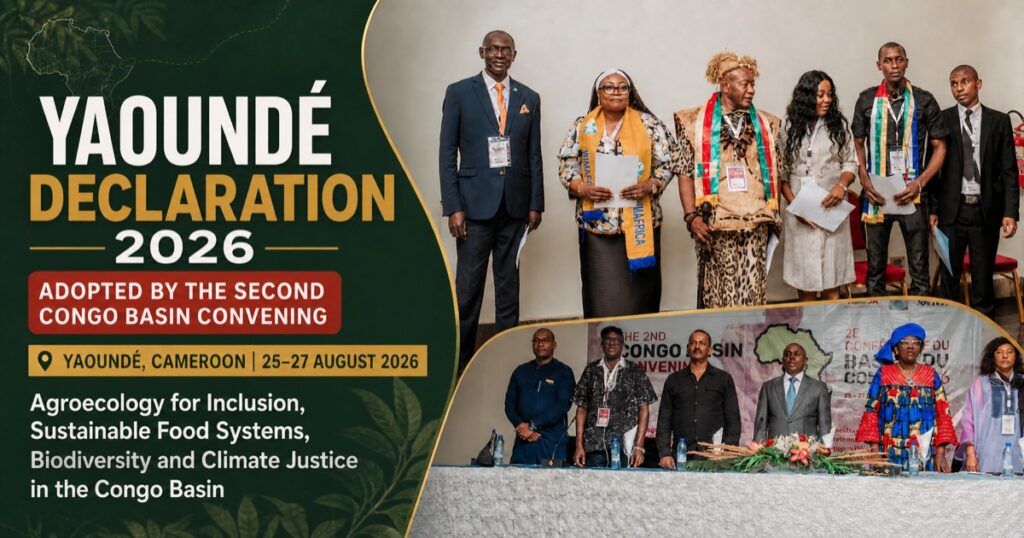
Yaoundé, Cameroon — 27 August 2026. The Second Congo Basin Convening has closed in Yaoundé with the adoption of the Yaoundé Declaration 2026, a 24-point regional pact on agroecology, food systems, biodiversity and climate justice in the Congo Basin. Over three days, 187 delegates from 20 countries — governments, farmers’ and pastoralists’ organisations, Indigenous Peoples, women’s and youth movements, researchers, parliamentarians, regional institutions, funding partners and media — worked through the progress made since the first Convening in Kinshasa in 2023 and turned it into a single, shared document. The official closure was pronounced by H.E. Mounouna Foutsou, Cameroon’s Minister of Youth Affairs and Civic Education, represented by Dr Akede Metounge Erik, who received the Declaration on the Minister’s behalf and committed to sharing it with the relevant government ministries.
The Declaration does not deal in vague aspiration. It calls on governments and the African Union Commission to name agroecology explicitly in national and regional agriculture investment plans, with at least 30 percent of relevant budget allocations dedicated to it. It demands that community and customary land rights be secured, that free, prior and informed consent apply without exception to conservation and extractive projects, and that farmer-managed seed systems be protected in law. It urges the Green Climate Fund, the African Development Bank and other financing partners to open direct-access windows so that at least 20 percent of climate and biodiversity finance reaches farmer organisations, women, youth, Indigenous Peoples and local communities directly — and it calls for a dedicated regional financing mechanism for agroecology, so the transition no longer runs on project cycles.
Alongside these calls to decision-makers, the Declaration binds its own signatories to action: farmer and community movements commit to seed banks and farmer-to-farmer training; civil society to a permanent cross-basin consultation space; governments to public annual reporting on what has been allocated and delivered; regional bodies to harmonised policy and cross-border trade; researchers, private-sector actors and media each to their own stated commitments. To carry it forward, the Convening adopted a Congo Basin Regional Action Roadmap and mandated the Alliance for Food Sovereignty in Africa (AFSA) to raise funding for the implementation of the Congo Basin Biodiversity, Climate and Agroecology Initiative (COBCAI) and to host the regional coordination unit, while each of the six Congo Basin countries establishes or strengthens its own national platform. Progress will be published annually and reviewed, call by call and commitment by commitment, at the Third Congo Basin Convening.
Four voices marked the closing session. Elisabeth Atangana, President of CNOP-CAM and Treasurer of the AFSA Board, begged the participants to repeatedly ask themselves: “What part of the Declaration depends on me?” The history of the Basin, she said, will be written by those who turn commitments into action, not by those who make the finest speeches.
Dr Million Belay, AFSA’s General Coordinator, reminded delegates how the region is read from outside: a carbon sink, and a place to extract minerals. Seventy-five percent of the world’s cobalt comes from Congo. The entire energy transition rests on it, which puts the people of the Basin at the centre of the global climate conversation. “We need resources, we need money,” he said. “But when we come back, we will do the work, whether there is money or not.”
Baba Adama, for the AFSA Citizens’ Working Group, argued that Yaoundé had strengthened the bridge between governments, communities and partners, and that protecting the Basin is everyone’s job. Dr Akede Metounge Erik closed with the line that may define what comes next: “Ecosystems do not negotiate. They regenerate or degrade.”