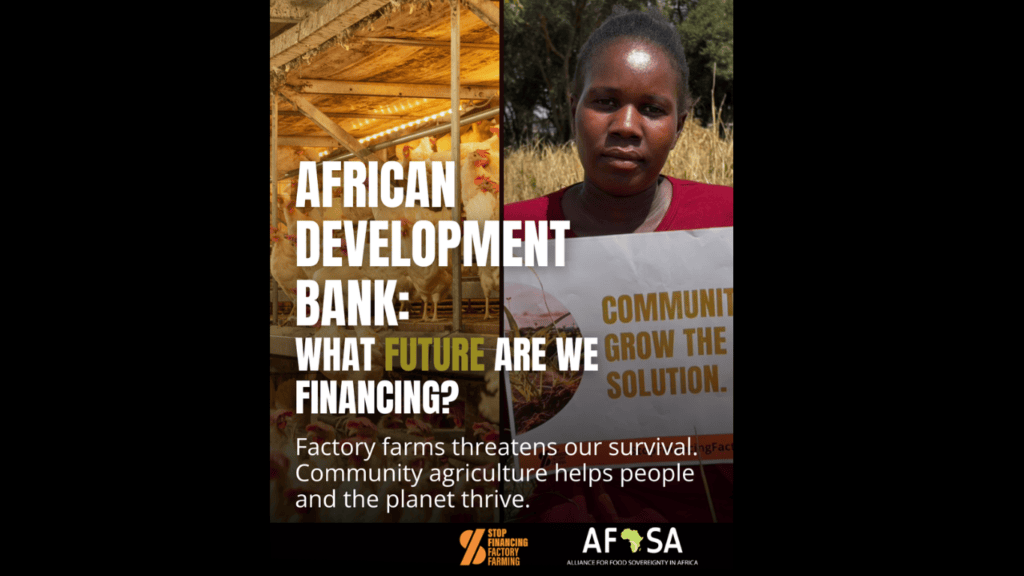
As the African Development Bank meets to mobilise finance, new research asks: finance for whom — and on what false premise?
PRESS RELEASE
FOR IMMEDIATE RELEASE · Brazzaville, Republic of Congo · 27 May 2026
BRAZZAVILLE — As delegates gather at the Kintélé Conference Centre this week for the African Development Bank Group’s 2026 Annual Meetings, convened under the theme “Mobilising Africa’s Development Financing at Scale,” the Alliance for Food Sovereignty in Africa (AFSA) is pressing a sharper question on the Bank: not how much finance is mobilised, but who it serves — and whether the assumptions behind it hold up at all.
Two recent AFSA studies — a portfolio analysis of the Bank’s agricultural financing from 2019 to 2025, and a closer look at the 40 Dakar 2 “Feed Africa” country compacts — find that the Bank has become one of Africa’s most influential agricultural financiers, channelling billions into value chains, agro-industrial zones and large agribusinesses, while support for the diversified, farmer-led systems that feed most of the continent remains marginal. A third study, by the Institute for Poverty, Land and Agrarian Studies (PLAAS) at the University of the Western Cape, goes further — dismantling the very narrative of “idle” and “available” land on which the Feed Africa agenda rests.
Key findings
The premise is flawed. The PLAAS study finds the claim that Africa holds vast “unused” or “underutilised” land for large-scale agriculture — a narrative the Bank has actively promoted — to be empirically and ideologically false, echoing colonial-era “empty land” myths. Much of the land labelled idle is already used for grazing, gathering, shifting cultivation and ecological functions, and carries layered customary claims. Smallholders manage some 80 percent of Africa’s farmland and supply up to 80 percent of sub-Saharan Africa’s food.
Industrial financing dominates. Both sovereign lending and a fast-growing private-sector window concentrate on fertilisers, hybrid seeds, mechanisation, irrigation and industrial processing, with little for agroecological transformation.
“Climate-smart” finance often reproduces the same model. Nearly half of agricultural approvals are labelled climate finance, but most replicate Green Revolution input packages rather than diversified, ecosystem-based approaches. None of the 20 projects assessed reached high agroecological alignment; flagship programmes such as TAAT and the agro-industrial processing zones scored lowest.
Transparency and participation gaps persist. Lending routed through banks and funds makes public money hard to trace, and communities frequently experience consultation without influence.
The compacts risk reshaping land and seeds. The Dakar 2 compacts implicate more than 11 million smallholders in industrial schemes — often as contract suppliers with limited control over their land, crops or prices — and advance land acquisition and certified seed systems that can displace farmer-managed seeds.
“The real question is what this finance does once it reaches the ground. It is overwhelmingly funding an industrial model that sidelines smallholders and calls high-input monocultures ‘climate-smart.’ Africa’s farmers are not asking the Bank to stop investing — they are asking it to invest in the systems that actually feed the continent.”
— Million Belay Ali (PhD), General Coordinator, Alliance for Food Sovereignty in Africa
What AFSA is calling for
This is a call for recalibration, not rupture. The Bank has the capacity and mandate to lead a just transition, and AFSA shares this analysis in the spirit of partnership. AFSA urges the Bank’s Governors and management to:
- Establish an Agroecology Transition Window within Feed Africa — to finance diversified, low-input systems, farmer-managed seeds, agroforestry and soil regeneration.
- Require ecological performance indicators for all agriculture projects — and stop classifying high-input monocultures as climate-smart without clear evidence of resilience benefits.
- Strengthen transparency and community participation — by publishing sub-loans and beneficiaries, securing customary land rights and free, prior and informed consent, and demonstrating genuine consultation before disbursement.
- Protect local food markets and farmer-led systems — so that modernisation supports, rather than displaces, the territorial economies and seed systems most Africans rely on.
Evidence increasingly shows that financing for agroecology is not scarce: redirecting existing agricultural finance could support ecological practices, local markets and community-led innovation at scale. The choice before the Bank is not whether to invest, but in which Africa.
Notes to editors
AFSA is a pan-African platform of civil society networks — small-scale farmers, pastoralists, fisherfolk, indigenous peoples, faith and consumer groups, women and youth — with members active in 50 African countries, impacting some 200 million people.
About the research.
Tracking the Role of the African Development Bank in Reshaping African Agriculture analyses AfDB agricultural financing from 2019 to 2025 using financial-flow data, project documentation, key-informant interviews and the Agroecology Coalition Tool.
The Costs to Smallholders of AfDB’s Feed Africa Initiative examines the 40 Dakar 2 country compacts.
The land-availability findings are drawn from “Land Availability and Land-Use Changes in Africa” (2025), published by the Institute for Poverty, Land and Agrarian Studies (PLAAS), University of the Western Cape.
The 2026 AfDB Annual Meetings run from 25 to 29 May 2026 at the Kintélé International Conference Centre near Brazzaville, gathering delegates from the Bank’s 81 member countries.
Media contact: Kirubel Teshome: Kirubel.tadele@afsafrica.org