
AFSA Statement on the Outcomes of COP31 and the Road to COP32 in Ethiopia
The Alliance for Food Sovereignty in Africa (AFSA) expresses profound disappointment with the outcome of the 31st United Nations Climate Change Conference (COP31), which concluded in Antalya, Türkiye, on 22 November 2026 without agreement on an overarching climate pact. A conference presented as an opportunity to move from commitments to implementation ended with deep divisions, inadequate progress on climate finance and critical decisions deferred. For Africa’s millions of farmers, pastoralists, fisherfolk, Indigenous Peoples, women and young people already confronting the devastating impacts of climate change, this represents another painful failure of political will.
AFSA, a continental alliance of more than 40 networks representing approximately 200 million food producers and communities across 50 African countries, went to COP31 with clear expectations. We called for agroecology to be recognised and financed as a central response to the climate crisis, a decisive agreement on the future of agriculture under the UNFCCC, accessible adaptation finance, and a just transition that protects the rights and livelihoods of African food producers. We expected governments to turn years of negotiations into meaningful support for communities. Antalya failed to deliver on these expectations.
“We came to Antalya carrying the voices of millions of African farmers and communities who are already living with the consequences of a climate crisis they did little to create. We leave deeply disappointed that the world has once again failed to match their suffering with meaningful action. Africa is not asking for sympathy. We are demanding justice, accountability and the right to determine our own future. COP32 in Ethiopia must be where the voices of Africa’s food producers finally become decisions that change lives.”
Rev. Dr. Tolbert Thomas Jallah Jr., Chairperson of AFSA
Agriculture cannot remain trapped in endless negotiations
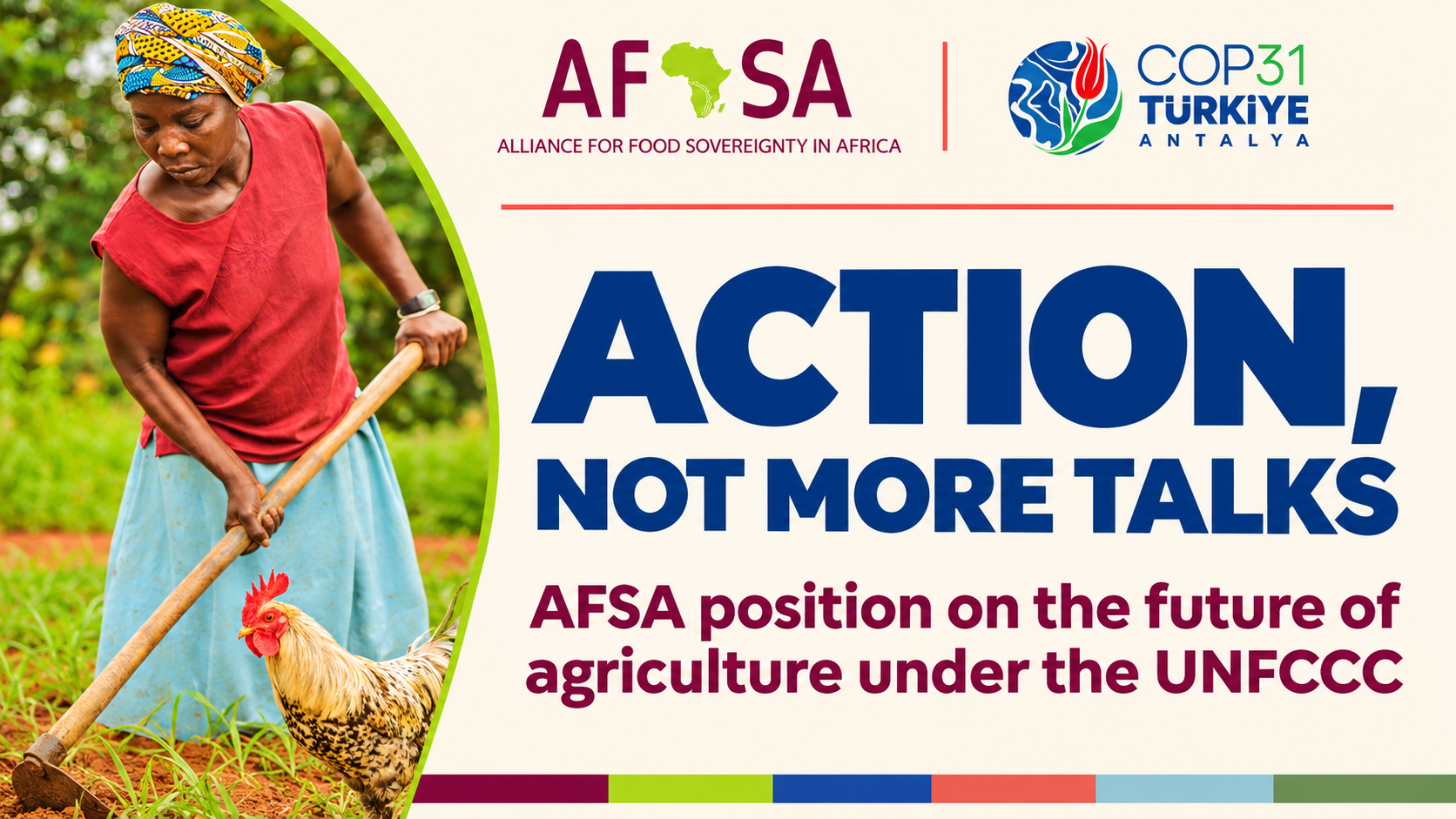
The most disappointing outcome for AFSA was the failure to reach a substantive agreement on the future of agriculture and food security under the UNFCCC. After nine years of discussions under the Koronivia Joint Work on Agriculture and the Sharm el-Sheikh Joint Work, negotiations again stalled, including over disagreements concerning food systems and trade-related language.
Rather than adopting a funded implementation framework, COP31 deferred further consideration to the June 2027 negotiations in Bonn, with another report to COP32. This is precisely the outcome AFSA warned against in its pre-COP31 position paper. Workshops, reports and dialogue cannot substitute for decisions that deliver resources to the people producing Africa’s food.
“For nine years, governments have negotiated agriculture while African farmers have been transforming their food systems with their own knowledge, seeds and resources. Agroecology is already delivering solutions for climate resilience, biodiversity and food sovereignty. What is missing is not evidence or another workshop. It is the political courage to recognise, finance and scale up these solutions. We cannot transform our food systems through negotiations that refuse to move beyond words.”
Dr. Million Belay, General Coordinator of AFSA
This failure has real consequences. Across Africa, communities are already losing crops and livestock to droughts, floods and extreme heat, while declining soil fertility, rising production costs and growing debt threaten their livelihoods. Every year of delay deepens their vulnerability. Africa’s food producers cannot continue paying the price for negotiations that repeatedly fail to move beyond discussion.
Climate finance remains a promise without delivery
COP31 also failed to provide the clarity and commitments necessary to deliver on the promise to triple adaptation finance by 2035. No credible financing baseline or sufficiently accountable delivery pathway emerged. This is particularly troubling for Africa, where adaptation is not a distant policy objective but an immediate necessity for survival, food security and economic stability.
“You cannot ask African farmers to adapt to a climate crisis and then deny them the resources to do so. Adaptation is already happening in our communities, but farmers are carrying the burden with almost no support. Tripling adaptation finance must mean money reaching the people restoring our soils, protecting our seeds and keeping our food systems alive. Without accessible, predictable finance, every promise made in these negotiation rooms remains an empty promise.”
Karen Nekessa, Co-Chair of AFSA’s Climate Change Working Group
AFSA reiterates that climate finance must be new, additional, predictable and predominantly grant-based. It must reach smallholder farmers, pastoralists, fisherfolk, women, youth and Indigenous communities directly, without creating further debt burdens. Investments must prioritise community-led agroecology, farmer-managed seed systems, soil and water restoration, biodiversity and resilient local food systems.
We cannot accept a climate finance system in which resources are repeatedly announced at international conferences but remain inaccessible to those facing the greatest risks.
Limited progress cannot conceal the wider failure
AFSA acknowledges that COP31 produced some institutional outcomes, including continued work on the Global Goal on Adaptation indicators, decisions concerning the Adaptation Fund and an extension of the Just Transition Work Programme. These provide opportunities for further engagement. However, the operational arrangements of the Just Transition Mechanism remain unresolved, and the conference failed to adopt its overarching Antalya Pact or agree on the continuation of the Mitigation Work Programme.
The failure to strengthen commitments on transitioning away from fossil fuels further exposed the gap between climate science and political action. We share the concerns raised by African negotiators and civil society movements over the persistent absence of finance, accountability and implementation.
For AFSA, a just transition must extend beyond energy to agriculture and food systems. It must protect land and seed rights, strengthen local economies, recognise Indigenous knowledge, and ensure that farmers and affected communities participate meaningfully in decisions shaping their future.
COP32 in Ethiopia must mark a turning point
Despite the disappointment in Antalya, AFSA sees the forthcoming COP32 in Addis Ababa, Ethiopia, as a significant opportunity to place Africa’s priorities at the centre of global climate negotiations.
“COP32 in Ethiopia presents a critical opportunity for Africa to turn its collective voice into meaningful climate action. We cannot afford to carry the same unresolved demands from one COP to another while our farmers continue to suffer. African civil society must come together, strengthen its engagement with governments and negotiators, and ensure that agroecology, food sovereignty and the needs of our communities are no longer pushed to the margins. COP32 must be where African priorities translate into decisions, financing and real change on the ground.”
Bridget Mugambe, Programmes and Networking Coordinator, AFSA
Throughout COP31, AFSA engaged with the Ethiopian government, African negotiators, civil society organisations and international partners to strengthen cooperation ahead of COP32. This engagement builds on the Addis Ababa Declaration adopted by African civil society in September 2026 and our collective commitment to advancing agroecology, food sovereignty and climate justice.
COP32 must not become another conference of promises. It must be a conference of delivery.
AFSA calls for a concrete, time-bound and financed decision on agriculture and food systems under the UNFCCC, with explicit recognition and support for agroecology. Governments must establish an accountable pathway for tripling adaptation finance, ensure direct access to grants for frontline communities, operationalise a just transition mechanism that includes agriculture, and integrate agroecology into Nationally Determined Contributions and National Adaptation Plans.
The Ethiopian COP32 Presidency, African governments and the international community must work together to ensure meaningful participation by African farmers, pastoralists, fisherfolk, women, youth and Indigenous Peoples in shaping these outcomes.
AFSA remains committed to working with its members, African governments, social movements and global partners to turn this opportunity into meaningful action.
Africa cannot afford another lost COP. The people who feed the continent deserve more than recognition, sympathy and promises. They deserve justice, resources and a decisive role in shaping their future.
The road to COP32 begins with a clear message from Africa. No more delays. No more empty commitments. It is time to deliver.