African civil society unveils a united negotiating position calling for firm commitments to implementation, direct climate finance and meaningful participation of food producers.
Antalya, Türkiye | 9 November 2026
Nine years of climate negotiations on agriculture. Countless workshops, reports and political declarations. Yet the farmers who feed Africa are still waiting for meaningful support. As COP31 opens its Food, Agriculture and Health Day in Antalya, the Alliance for Food Sovereignty in Africa (AFSA) is drawing a clear line: the era of endless discussions must give way to funded, accountable action.
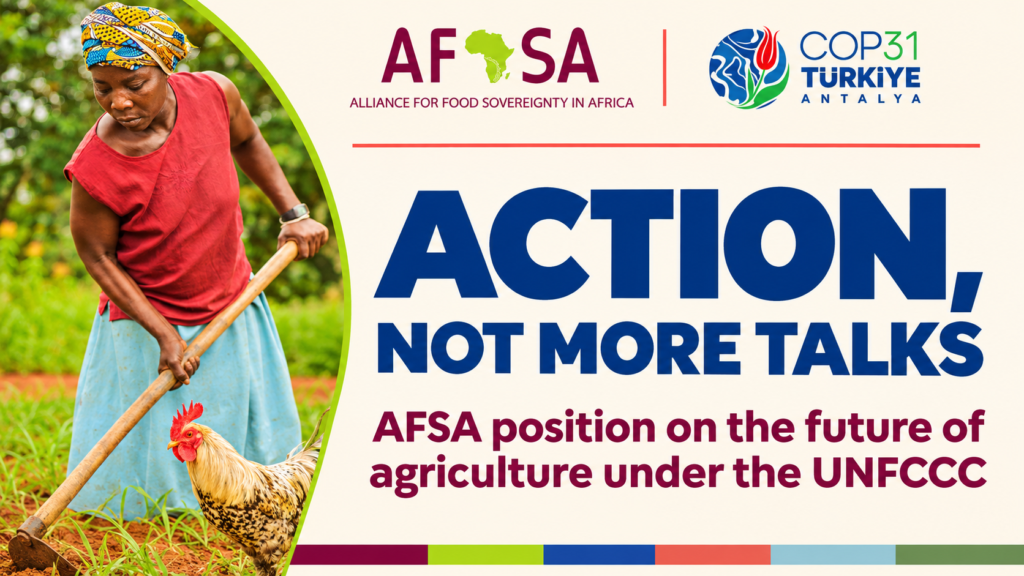
Today, AFSA officially launches Action, Not More Talks: AFSA Position on the Future of Agriculture under the UNFCCC, a collective African civil society position developed through sustained consultations, dialogue and refinement of shared demands. The document sets out what governments must deliver as the four-year Sharm el-Sheikh Joint Work on Implementation of Climate Action on Agriculture and Food Security (SJWA) reaches its conclusion at COP31.
The stakes could hardly be higher. Since the Koronivia Joint Work on Agriculture began in 2017, successive negotiating processes have generated extensive knowledge about climate change and agriculture but failed to translate that knowledge into accessible resources for the communities confronting the crisis. COP31 must not repeat Koronivia’s failure to turn accumulated knowledge into accessible support for food producers. According to evidence highlighted in AFSA’s position paper, just 0.8 per cent of climate finance reaches small-scale agrifood systems, while food systems receive only about 7 per cent of global climate finance.
For African farmers, pastoralists and fisherfolk, this failure has consequences measured not in negotiating texts, but in lost harvests, disappearing livelihoods, growing debt and deepening food insecurity.
“For nine years, the world has discussed the future of agriculture while the people who produce our food have waited for action. We cannot keep calling meetings progress when farmers return home to the same problems without the resources to address them. COP31 must answer a simple question: where is the money, who will deliver it, and when will it reach the people who need it? Anything less is another broken promise,” said Dr. Million Belay, General Coordinator of AFSA.
AFSA’s position is unequivocal. COP31 must deliver an operational decision on the future of agriculture under the UNFCCC, rather than renew the same cycle of reporting, workshops and dialogue that has characterised nearly a decade of negotiations. The future of agriculture must be secured through a dedicated, implementation-oriented framework with a funded action plan, measurable annual targets, clearly designated institutional responsibilities and independent public reviews tracking the climate finance that actually reaches food producers. The framework must also integrate community-led agroecology into Nationally Determined Contributions (NDCs) and National Adaptation Plans (NAPs), with national delivery plans developed alongside the communities they are intended to serve.
Crucially, AFSA demands that the findings of the SJWA workshops and annual synthesis reports be incorporated into the COP31 decision. The existing Sharm el-Sheikh online portal must evolve beyond an information-sharing platform into a publicly tracked mechanism connecting priorities identified by food producers with climate finance and technical assistance.
At the heart of these demands is agroecology, which AFSA calls on governments to explicitly recognise and fund as a viable approach to climate adaptation and mitigation. Farmer-managed seed systems, soil restoration, biodiversity conservation and local food systems are already strengthening resilience across Africa. Their expansion requires dedicated public investment, accessible grants and integration into national climate plans.
“Agroecology cannot remain a paragraph in a negotiating document while the systems sustaining African communities struggle for support. Recognition without financing changes little. We are demanding a future agriculture framework that puts farmers at the centre of decisions, funds the solutions they are already developing, and makes governments accountable for delivery. That is what meaningful implementation must look like,” said Karen Nekessa, Chair of AFSA’s Climate and Agroecology Working Group.
The position further calls for new and additional, predictable, grant-based climate finance with simplified direct access for small-scale producers, accountability for developed countries under Article 9.1 of the Paris Agreement, and guaranteed participation of farmers’ organisations, Indigenous Peoples, women and youth in designing, implementing and reviewing the new programme.
Representing more than 40 networks and approximately 200 million people across 50 African countries, AFSA brings this collective position to COP31 as a clear negotiating mandate. It is the product of a sustained African civil society effort to ensure that the future of global agricultural climate policy is shaped by those most affected by its decisions.
As governments determine what comes after the Sharm el-Sheikh Joint Work, the choice is no longer between different ways of continuing the conversation. It is between another cycle of promises and a credible pathway to delivery.
Africa’s food producers have waited nine years. They should not be asked to wait another four.
Read AFSA’s full position paper:
EN: Action, Not More Talks: AFSA Position on the Future of Agriculture under the UNFCCC.
FR: Des actes, pas davantage de discussions : Position de l’AFSA sur l’avenir de l’agriculture dans le cadre de la CCNUCC.