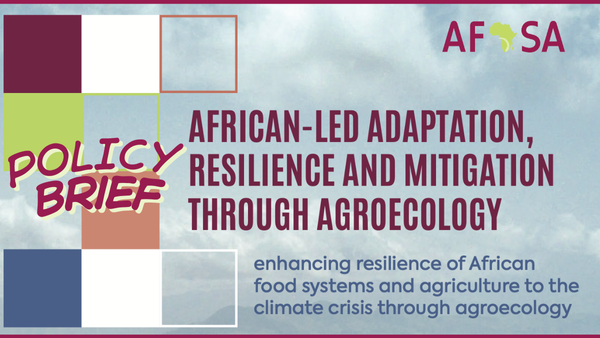
The Alliance for Food Sovereignty in Africa (AFSA) will officially launch its new Policy Brief on Agroecology as Africa’s Climate Solution at the Second Africa Climate Summit (ACS2), hosted in Addis Ababa from 8–10 September 2025.
The brief presents AFSA’s strategic position that agroecology is Africa’s holistic, people-centered pathway for adaptation, resilience, and mitigation in the face of escalating climate shocks. It calls on governments and the African Union to move beyond extractive, market-driven models and instead invest in farmer-led, community-driven solutions that strengthen sovereignty, biodiversity, and food security.
Climate change has already reduced Africa’s agricultural productivity growth by 34% since 1961, with droughts, floods, heatwaves, and pests devastating smallholder farmers. Industrial, input-heavy models have failed to deliver, leaving degraded soils, eroded biodiversity, and growing dependency. Agroecology offers a proven alternative — restoring ecosystems, empowering women and youth, and embedding indigenous knowledge into climate strategies.
Key Calls from the Policy Brief
- Integrate agroecology into NDCs and National Adaptation Plans.
- Implement the AU Climate Strategy (2022–2032) and Agenda 2063 with agroecology as a flagship approach.
- Redirect climate finance toward community-led transitions, ensuring direct access for farmers, women, and youth groups.
- Reaffirm agroecology in climate negotiations, making it central to Africa’s position toward COP30.
By championing agroecology, AFSA urges African leaders to seize the Second Africa Climate Summit as a turning point for a just, sovereign, and climate-resilient future.