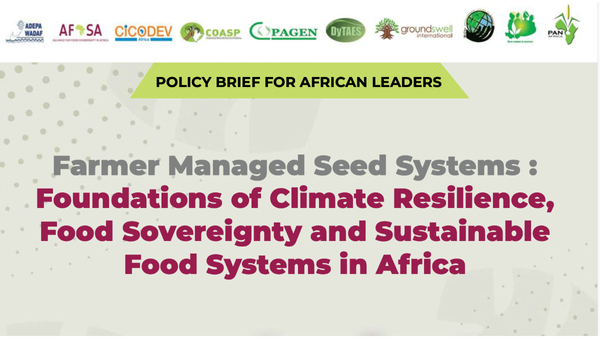

The Alliance for Food Sovereignty in Africa (AFSA) has released a new policy brief calling on African leaders to urgently recognize and support Farmer Managed Seed Systems (FMSS) as a cornerstone of climate resilience, food sovereignty, and sustainable food systems across the continent. The brief will be officially launched at the Africa Food Systems Forum, hosted in Senegal from 31 August to 5 September 2025, where high-level African ministers and policymakers are convening to shape the future of food and agriculture.
Today, over 80 to 95% of seeds planted by smallholder farmers in sub-Saharan Africa come from these farmer-led systems, which embody ancestral agroecological knowledge, preserve biodiversity, and ensure resilience in the face of climate shocks. Women and youth are the backbone of FMSS—women safeguard up to 90% of traditional seed knowledge—yet these systems remain marginalized by restrictive seed laws, corporate pressures, and policies favoring industrial seeds.
AFSA warns that neglecting FMSS risks further biodiversity loss, weakened climate adaptation, and deepened food insecurity. By contrast, recognizing and investing in FMSS offers a “Made-in-Africa” solution to today’s food crisis—one that reduces dependence on costly seed imports, creates green jobs for youth, empowers women, and secures nutritious food for millions.
Key Recommendations
The policy brief urges African governments to:
- Legally recognize FMSS in national seed laws, ensuring farmers’ rights to freely save, use, exchange, and sell seeds.
- Invest in infrastructure and financing, including community seed banks, participatory breeding, and farmer training.
- Integrate FMSS into education and research, supporting co-creation of knowledge between farmers, scientists, and institutions.
- Promote inclusion and equity, strengthening the role of women and youth as leaders and innovators in seed systems.
AFSA emphasizes that FMSS are not relics of the past but living pillars of Africa’s food future. They represent a strategic imperative to secure food systems, protect Africa’s genetic heritage, and reduce external dependence.
As the brief concludes, “The seed does not refuse to grow—let us give it the political soil it deserves.”