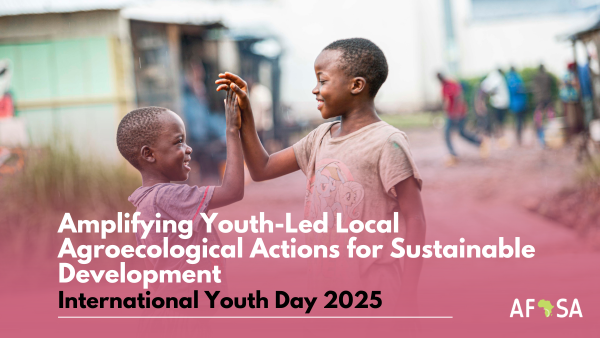

International Youth Day 2025
Theme – “Local Youth Actions for the SDGs and Beyond”
12th August 2025
On this International Youth Day 2025, the AFSA Youth and Agroecology Working Group affirms its unwavering commitment to harnessing the power of youth-led local actions to drive agroecological transformation and sustainable development across Africa. Under the theme “Local Youth Actions for the SDGs and Beyond”, we spotlight the critical role that youth play in bridging global aspirations with grassroots realities, especially through agroecology, a people-centered, sustainable, and transformative approach to achieving resilient food systems and communities.
As the world works to achieve the set Sustainable Development Goals (SDGs), the time has come to recognize that global ambitions must be realized through local action. Young people, deeply rooted in their communities, are uniquely positioned to lead and localize the SDGs through agroecological innovations, traditional knowledge systems, and climate-resilient practices. Their actions are not only accelerating progress, but they also lay the foundation for more just, inclusive, and resilient food systems.
Agroecology as a youth-driven local pathway to sustainable development
Agroecology offers a unifying framework to address intertwined challenges of climate change, biodiversity loss, hunger, poverty, and land degradation. Youth across Africa are responding to these challenges with bold, place-based actions, transforming degraded landscapes, reviving indigenous seed systems, reducing chemical inputs, regenerating soils, and building enterprises and strengthening territorial markets that put people before profit.
By championing agroecology at the local level, youth are;
- Translating policies into practice by implementing agroecological farming methods aligned with national climate and food security strategies.
- Driving climate adaptation and resilience through ecosystem-based land management practices that sustain livelihoods and biodiversity.
- Creating inclusive economies by establishing agroecological enterprises that provide dignified work, especially for young women and marginalized groups.
- Reviving Indigenous Knowledge and Practices by actively reclaiming and applying traditional knowledge passed down through generations, combining it with modern science to regenerate the land, preserve food cultures, and build climate resilience.
- Revitalizing rural areas through circular economy models that prioritize local food systems and shorten value chains.
- Strengthening Territorial Markets by organizing community-supported agriculture, farmers’ cooperatives, and food fairs that promote access to healthy, local food and enhance community food sovereignty.
The power of local youth action
Youth-led local actions have ripple effects that go beyond their immediate communities. These actions drive national progress and contribute significantly to the achievement of more than 65% of the SDG targets that are rooted in local governance. By acting locally and thinking globally, youth are building a sustainable Africa from the ground up, one that values community, ecology, and justice.
As the AFSA Youth and Agroecology Working Group, we believe that youth must be supported, resourced, and recognized as central agents of transformation, not only in the implementation of the SDGs but also in envisioning what lies beyond them.
Our collective demands
As African youth committed to agroecology, we call on governments, development partners, civil society, and regional bodies to;
1. Institutionalize agroecology in Local Development Plans
Ensure that national and sub-national policies prioritize agroecology as a strategic pathway for achieving the SDGs and strengthening community resilience.
2. Invest in local youth-led agroecological enterprises
Provide targeted funding, training, and incubation support to youth enterprises rooted in agroecological principles to boost local economies and sustainable job creation.
3. Secure access to land, water, and seeds
Enact and enforce land tenure policies that prioritize youth access to productive resources and protect indigenous seed systems essential for healthy and sustainable food systems.
4. Embed agroecology and environmental education in schools
Reform curricula to include practical agroecology and SDG localization modules, enabling young people to learn, act, and lead in their communities.
5. Facilitate youth participation in local and national governance
Establish formal mechanisms for youth involvement in national and subnational agricultural, environmental, and food policy processes, ensuring their voices shape decisions that affect their lives and futures.
6. Promote territorial markets and local food systems
Support infrastructure, information systems, and policy frameworks that empower youth to strengthen local markets and reduce dependence on industrial food chains.
7. Strengthen youth networks and alliances for agroecology
Facilitate cross-country networks that enable youth to share knowledge, coordinate actions, and amplify their collective impact on food systems and climate resilience.
Local youth action is the heartbeat of sustainable development.
On this International Youth Day 2025, we reaffirm our commitment as African youth to lead locally rooted, globally significant agroecological transformations. Our power lies in our connection to our land, our communities, and our collective vision for food systems that are just, sustainable, and sovereign.
Let us act, innovate, and lead locally for the Africa and the planet we deserve!!!!