
AFSA PRESS STATEMENT
AFSA Responds to the International Workshop on Genome Editing in Agricultural Crops, 17–18 November 2025, Senegal
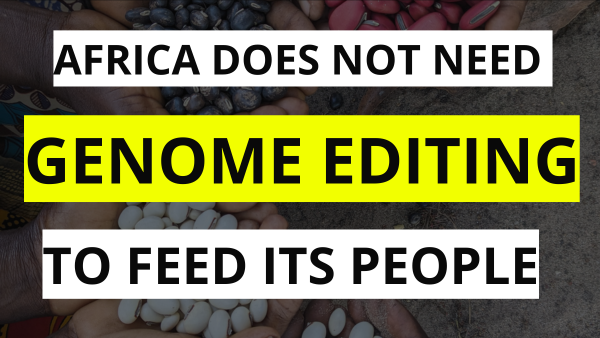
Africa does not need genome editing to feed its people.
The Alliance for Food Sovereignty in Africa (AFSA) issues this statement in response to the international workshop on genome editing and its applications in agricultural crops taking place in Senegal on 17 and 18 November 2025. While presented as a neutral scientific exchange, this workshop forms part of a much wider continental push to normalise, deregulate, and ultimately commercialise genome editing technologies in Africa – without public debate, without independent oversight, and without regard for the continent’s seed sovereignty, biodiversity, or long-term food security.
Africa does not need genome editing to feed its people. Africa needs bold public policies that strengthen farmer-managed seed systems, protect biodiversity, secure farmers’ rights, and scale agroecology – the proven pathway to food sovereignty.
A coordinated campaign to influence African agricultural policy
Extensive analysis from the African Centre for Biodiversity (ACBio) has documented a well-funded, well-coordinated campaign to promote genome editing across the continent. This includes:
- Support from powerful external actors – USAID, USDA, the Bill & Melinda Gates Foundation, CGIAR centres, and multinational agribusiness companies.
- AUDA-NEPAD-driven efforts to harmonise permissive regulatory frameworks.
- A parallel communication infrastructure (OFAB, journalist training, media awards, and “champion” networks) designed to shape public opinion in favour of genome editing.
- Training and capacity-building programmes aimed at ensuring elite scientific and policy alignment with corporate technological agendas.
This workshop in Senegal is part of that strategy.
Genome editing remains experimental and unproven
Despite a decade of hype, genome editing has not delivered on its promises:
- Very few gene-edited crops have reached field trials in Africa.
- Even fewer have been independently evaluated for safety or agronomic benefit.
- Most projects remain confined to laboratories or small controlled trials.
- There is still no evidence that genome editing can deliver large-scale, climate-resilient, farmer-friendly solutions for Africa’s diverse food systems.
Yet the pressure to deregulate these technologies is intensifying.
Deregulation threatens biosafety, farmer rights, and Africa’s genetic heritage
Many African countries are being encouraged to exempt gene-edited organisms from biosafety regulation if they do not contain “foreign DNA”. These product-based systems – now adopted or proposed in Nigeria, Kenya, Ghana, Burkina Faso, Malawi, and Ethiopia – create dangerous loopholes:
- Gene-edited organisms can enter seed systems with no risk assessment.
- Off-target effects or unforeseen ecological consequences may go undetected.
- Patented genomic changes allow companies to claim ownership over naturally occurring genetic sequences.
- Farmers’ rights to save, exchange, and sell seed are undermined.
- Africa’s biodiversity becomes vulnerable to enclosure through intellectual property regimes.
This is not scientific progress – it is the quiet restructuring of Africa’s seed systems in favour of private interests.
A democratic deficit: where is the public?
Across the continent, regulatory changes have been developed without:
- Farmer consultation
- Public participation
- Parliamentary debate
- Independent scientific review
Workshops such as this one risk becoming rubber-stamping exercises for predetermined agendas. Science must serve the public interest – not bypass it.
African solutions already exist: agroecology and farmer-managed seed systems
The real, proven pathways to food sovereignty include:
- Agroecology and ecological farming practices
- Farmer-managed seed systems and community seed banks
- Participatory plant breeding
- Diversification, intercropping, and agroforestry
- Policies that support territorial markets and strengthen rural livelihoods
These approaches are already boosting yields, restoring soil health, enhancing resilience, and improving nutrition – without corporate dependency or ecological risk.
Genome editing is not an African priority. It is a costly distraction.
AFSA’s Call to Action
AFSA calls on African governments, policymakers, and workshop participants to commit to the following:
- Declare a moratorium on the release and deregulation of genome-edited organisms until transparent, independent biosafety systems are in place.
- Apply the precautionary principle and strengthen biosafety regulation in line with the Cartagena Protocol.
- Guarantee farmers’ rights, including the right to save, exchange, improve, and sell seed.
- Ensure full transparency: all data – including information claimed as “trade secrets” – must be publicly accessible.
- Reject externally imposed public-private partnerships that undermine sovereignty.
- Redirect public resources toward agroecology, local markets, and farmer-led research.
- Protect Africa’s genetic heritage from biopiracy and corporate monopolies.
Africa must choose sovereignty, not dependency
The future of African agriculture must not be decided in closed-door meetings. It must be built by farmers, Indigenous Peoples, pastoralists, fisherfolk, women, youth, and the communities who feed the continent.
Genome editing is not inevitable. Africa has the right to choose a food system grounded in biodiversity, justice, resilience, and sovereignty.
AFSA stands firm: Our seeds, our food, our future.

