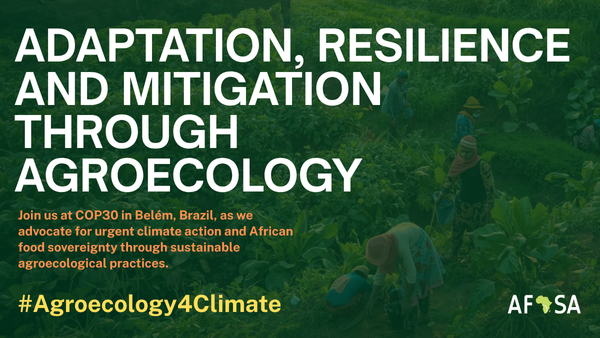

From Commitments to Action: AFSA Calls on COP30 to Institutionalize Agroecology in Global Climate Frameworks
Belém, Brazil – November 2025 – As global leaders convene for the 30th Conference of the Parties (COP30) to the UNFCCC, the Alliance for Food Sovereignty in Africa (AFSA) has officially launched a major policy brief titled “Adaptation, Resilience and Mitigation through Agroecology.” The release marks a defining moment for African civil society at the climate negotiations, placing agroecology firmly at the heart of Africa’s strategy for climate adaptation and resilience.
Representing a powerful coalition of 48 network organizations that bring together more than 200 million small-scale food producers, pastoralists, Indigenous Peoples, youth, women, and faith-based communities across 50 African countries, AFSA’s new policy brief presents a strong, evidence-based case for the recognition and institutionalization of agroecology as a key climate solution.
The brief underscores that Africa’s agriculture, employing over 60 percent of the continent’s workforce and largely rain-fed, faces escalating climate risks that threaten food security, livelihoods, and ecosystems. It calls for a decisive shift from rhetoric to implementation through community-driven and scientifically grounded adaptation strategies.
Rooted in the outcomes of SB62 and building on advocacy milestones from COP29 and earlier negotiations, the policy brief outlines AFSA’s priorities across six major thematic areas: the Global Goal on Adaptation (GGA), the Sharm el-Sheikh Joint Work on Agriculture (SJWA), National Adaptation Plans (NAPs), Nationally Determined Contributions (NDCs), the Just Transition Work Programme, and Climate Finance. It calls on Parties to ensure that agroecology is embedded across these negotiation tracks as a measurable and central pillar for resilience, adaptation, and mitigation.
Under the Global Goal on Adaptation, AFSA urges Parties to adopt agroecology as a key enabler of Target 9(b) within the emerging indicator framework, recognizing its measurable contributions to climate-resilient food systems and equitable access to adequate nutrition.
Within the SJWA, AFSA calls for agroecology to be institutionalized beyond 2026 as a holistic and systemic approach to agricultural adaptation and for the online portal to serve as an inclusive platform for coordination and knowledge sharing.
On National Adaptation Plans, AFSA highlights the need to mainstream agroecological actions, particularly farmer-led initiatives on soil health, biodiversity restoration, water management, and seed systems, and to prioritize grant-based finance for local implementation. For NDCs, it calls on Parties to integrate agroecology as a dual adaptation and mitigation strategy that restores soil carbon, enhances biodiversity, and strengthens food sovereignty, while ensuring coherence with NAPs and Just Transition frameworks.
The policy brief also urges negotiators to adopt a Just Transition framework in agriculture that centers smallholders, women, youth, and Indigenous Peoples, embedding agroecology in decarbonization strategies that safeguard livelihoods.
On Climate Finance, AFSA pushes for scaled-up, predictable, and grant-based funding mechanisms, ensuring that community-driven agroecological initiatives receive direct, accessible, and trackable support.
AFSA’s recommendations to Parties at COP30 are clear; recognize agroecology as a cornerstone for achieving just and sustainable food systems, operationalize adaptation indicators that capture local realities, institutionalize the participation of grassroots communities in climate governance, and establish transparent accountability for climate finance.
The brief draws on extensive evidence, including studies showing that agroecological practices can reduce production costs by up to 60 percent, restore soil fertility through legume intercropping, enhance pollinator populations by 25 percent, and diversify food sources to improve nutrition and sovereignty.
As COP30 unfolds in Belém, the brief stands as AFSA’s rallying call for Parties to move from commitments to concrete action, transforming Africa’s food systems through agroecology, for people and for the planet.